



Palbocent 125 mg Capsule (Palbociclib) | (CDK4/6) Inhibitor
$ 98.42
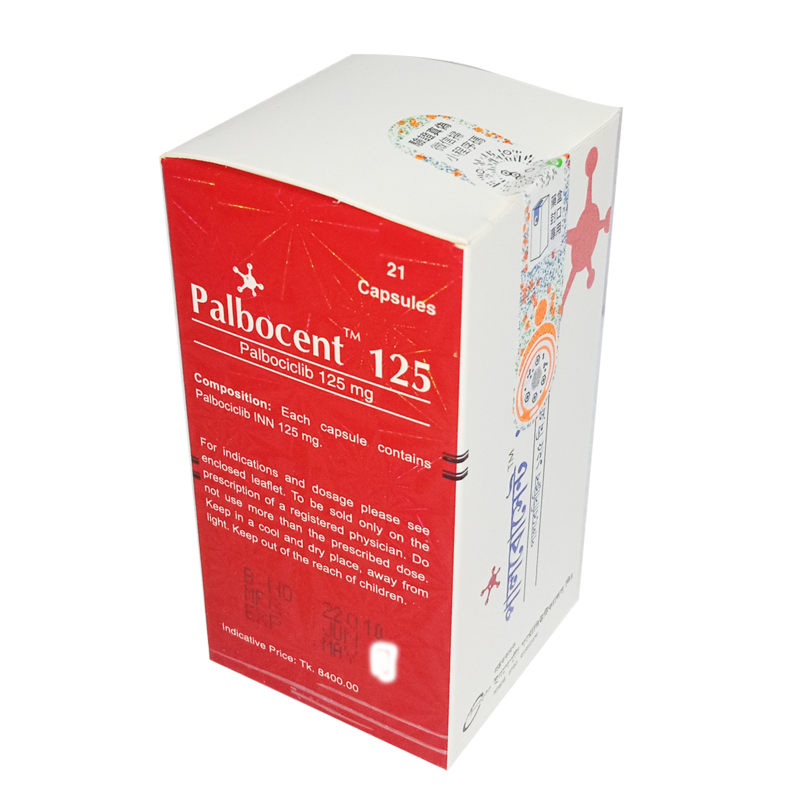
Palbocent contains 125 mg of the active pharmaceutical ingredient Palbociclib. It is an orally administered targeted therapy classified as a CDK4/6 inhibitor. Palbocent is utilized exclusively in the management of advanced or metastatic breast cancer that is hormone receptor-positive (HR ) and HER2-negative. By interrupting specific enzymatic pathways that regulate cell division, Palbociclib effectively halts the proliferation of malignant breast tissue cells. It is structurally designed to be used in combination with endocrine (hormone) therapy to overcome acquired clinical resistance and significantly prolong disease control.“CDK4/6 inhibitors changed the front-line treatment paradigm for HR /HER2− metastatic breast cancer almost overnight. The single most important thing I tell patients is that neutropenia is not a rare side effect — it is the expected, dose-defining toxicity in the majority of patients. The monitoring schedule is not optional — it is how we catch problems before they become serious.”— Dr. Salma Mamdouh Elreedy, Clinical Oncologist, Sphinx Cure Oncology CenterWhat is Palbocent 125 mg?Palbocent 125 mg is an oral targeted therapy used to treat certain types of advanced or metastatic breast cancer. Its active ingredient is palbociclib, and it belongs to a class of medicines called CDK4/6 inhibitors. Palbocent is manufactured by Incepta Pharmaceuticals as a generic equivalent to the innovator brand Ibrance.It is always used in combination with another hormone therapy — never on its own. Depending on your situation, your oncologist will prescribe it alongside either an aromatase inhibitor or fulvestrant.Who is it for?Palbocent is indicated for adult patients with hormone receptor-positive (HR ), HER2-negative advanced or metastatic breast cancer:Postmenopausal women or men, combined with an aromatase inhibitor (such as letrozole), as the first treatment for advanced or metastatic disease.Women whose disease has progressed after prior hormone therapy, combined with fulvestrant as second-line treatment.Your oncologist will confirm your HR and HER2− status via a biopsy test (IHC or ISH assay)before starting Palbocent. This step is essential to confirm the medicine is right for your cancer.How does Palbocent work?In HR breast cancer, estrogen signals tell the cancer cell to activate two specific enzymes — CDK4 and CDK6. Think of these enzymes as the “on switch” that allows cancer cells to copy their DNA and divide into new cells.Palbociclib physically blocks CDK4 and CDK6, trapping cancer cells in the G1 phase of the cell cycle — the phase just before DNA copying begins. This puts the tumour into a state of cellular arrest.Your companion hormone therapy (letrozole or fulvestrant) reduces the estrogen signal, while palbociclib simultaneously blocks the downstream machinery that signal activates. This dual-attack strategy delays the cancer from developing resistance to treatment, which is why the combination is far more effective than either therapy alone.How to take Palbocent 125 mgYour dosing schedulePalbocent works on a strict 28-day cycle. You take the capsule every day for 21 days, then stop for 7 days to allow your bone marrow to recover. Then you start the next cycle. This pattern continues for as long as your oncologist recommends.StepWhat to doDays 1–21Take one 125 mg capsule by mouth, once daily, with foodDays 22–28Stop — no capsule for 7 days (bone marrow recovery period)Day 29Start the next 28-day cycleTaking your capsule correctlyAlways take with food — this ensures the drug is properly absorbed. Taking it on an empty stomach significantly reduces how much reaches your bloodstream.Swallow capsules whole with a glass of water. Do not chew, crush, or open them.Take at the same time every day to maintain stable drug levels.If you miss or vomit a doseDo not take an extra dose to make up for a missed or vomited one. Simply take your next dose at the regular time the following day and continue as normal.Why the 7-day break?Palbociclib temporarily affects healthy dividing cells in your bone marrow as well as cancer cells. The 7-day rest period allows your white blood cell count — particularly neutrophils, which fight infection — to recover before the next cycle begins. Skipping or shortening this break can lead to dangerously low counts.Blood tests and monitoringBecause Palbocent commonly lowers white blood cell counts, your oncologist will schedule regular blood tests throughout your treatment. This is not optional — it is how your team keeps you safe.WhenWhat is checkedWhyBefore startingFull blood count (CBC)Confirm counts are safe to beginStart of every cycleFull blood count (CBC)Check recovery after the 7-day breakDay 15 of cycles 1 and 2Full blood count (CBC)Catch neutropenia at its lowest pointBaseline and periodicallyLiver function (ALT, AST)Monitor for liver stressEvery visitRespiratory symptomsWatch for signs of lung inflammationBaseline as neededECG (heart rhythm)Monitor QT interval if at riskURGENT: If you develop a fever (38.5°C / 101.3°F or higher) at any time during treatment,contact your oncologist immediately — even outside of clinic hours. Fever combined with lowwhite cell counts (febrile neutropenia) is a medical emergency. Do not wait for your next appointment.Dose adjustmentsDose reductions are a normal, planned part of managing Palbocent. They are not a sign that treatment has failed. There are three dose levels: 125 mg → 100 mg → 75 mg — all taken on the same 21/7 schedule.SituationActionNeutrophils low but no fever (Grade 3, ANC 0.5–1.0)Pause Palbocent; resume at same dose once recoveredGrade 3 neutropenia recurs after resumingReduce one dose level (e.g. 125 mg → 100 mg)Grade 3 with fever ≥38.5°C, or Grade 4 (ANC <0.5)Pause until recovery, then reduce one dose levelSevere non-blood toxicity that does not resolvePause until Grade ≤1, then reduce one dose levelCannot tolerate 75 mgPermanently discontinue PalbocentNever adjust your dose yourself. All changes must be directed by your oncologist based on your blood results and symptoms.Side effectsVery common (more than 1 in 5 patients)Low white blood cells (neutropenia) — expected in most patients; managed with dose adjustmentsInfections — avoid crowded spaces and people who are unwellFatigueNausea — eat small, frequent meals and stay well hydratedMouth sores (stomatitis) — use a soft toothbrush and alcohol-free mouthwashAnaemia (low red blood cells)Hair thinning (alopecia) — typically mild to moderate, not complete hair lossDiarrhoeaSerious side effects — seek immediate medical attentionFebrile neutropenia: Fever plus low white cell count — contact your team immediatelyInterstitial lung disease / pneumonitis: New or worsening dry cough, shortness of breath, or chest discomfort. Rare but potentially serious — seek emergency care if these develop.Severe liver enzyme elevation: Usually caught on routine blood tests; tell your doctor about any yellowing of skin or eyes, dark urine, or severe fatigue.Medicines and foods to avoidPalbociclib is processed by a liver enzyme called CYP3A4. Medicines and foods that affect this enzyme can change how much Palbocent is in your bloodstream — either increasing toxicity or reducing effectiveness.Interacting substanceEffectWhat to doStrong CYP3A4 inhibitors (e.g. ketoconazole, itraconazole, clarithromycin, ritonavir)Increases Palbocent levels → risk of toxicityAvoid if possible; if unavoidable, dose reduced to 75 mg with close monitoringStrong CYP3A4 inducers (e.g. rifampin, carbamazepine, phenytoin, St. John’s Wort)Decreases Palbocent levels → reduced effectivenessAvoid entirelyGrapefruit / grapefruit juice / Seville orangesInhibits CYP3A4 → raises drug levelsAvoid completely during treatmentNarrow-index CYP3A substrates (e.g. tacrolimus, sirolimus, some statins like simvastatin)Palbocent may raise their levelsReview with oncologist; may need dose adjustment of the other drugAlways tell your oncologist and pharmacist about every medicine, supplement, and herbal product you are taking — including over-the-counter remedies. Review this list at every appointment.Special situationsSituationGuidancePregnancyPalbociclib can cause serious harm to a developing baby. Do not become pregnant while taking this medicine.Contraception — femalesUse highly effective contraception during treatment and for at least 3 weeks after the last dose.Contraception — malesIf your partner could become pregnant, use effective contraception during treatment and for at least 14 weeks after the last dose.BreastfeedingDo not breastfeed during treatment or for at least 3 weeks after the last dose.Children under 18Safety and effectiveness have not been established in patients under 18.Older adults (65 )No overall difference in safety or effectiveness compared to younger patients.Mild or moderate kidney impairmentNo dose adjustment required (CrCl ≥15 mL/min). Not studied in patients on dialysis.Mild or moderate liver impairmentNo dose adjustment required.Severe liver impairment (Child-Pugh C)Reduced starting dose of 75 mg daily on the standard 21/7 schedule.Clinical evidencePalbociclib is backed by two landmark Phase 3 clinical trials — the PALOMA series — which formed the basis for global regulatory approval.TrialSettingResultPALOMA-2 (published in NEJM)First-line: Palbociclib letrozole vs letrozole alone in postmenopausal women with HR /HER2− advanced breast cancerMedian progression-free survival: 24.8 months (palbociclib) vs 14.5 months (letrozole alone) — a 71% improvementPALOMA-3 (published in NEJM)Second-line: Palbociclib fulvestrant vs fulvestrant alone in patients who progressed on prior hormone therapyMedian progression-free survival: 9.5 months (palbociclib) vs 4.6 months (fulvestrant alone) — more than doubledPalbocent does not cure metastatic breast cancer. It is a highly effective management therapydesigned to delay disease progression and maintain quality of life for as long as possible.How to store Palbocent 125 mgStore at controlled room temperature: 20°C to 25°C (68°F to 77°F). Brief excursions between 15°C and 30°C are permitted.Keep in the original blister packaging to protect from moisture and light.No refrigeration or cold chain is required.Do not use capsules past the expiry date printed on the packaging.Dispose of unused or expired capsules according to your local pharmaceutical waste guidelines — not in household rubbish, as Palbocent is classified as a cytotoxic medicine.Frequently Asked QuestionsWhy do I need so many blood tests?Palbociclib commonly lowers your neutrophil count (white blood cells that fight infection). Frequent blood counts — especially in the first two cycles and around Day 15 — let your team spot this early and adjust your dose before it becomes dangerous. This monitoring schedule is non-negotiable.Can I take Palbocent without the hormone therapy?No. Palbociclib is only approved and effective in combination with an aromatase inhibitor or fulvestrant. Taking it alone is not supported by clinical evidence. Always follow the combination regimen your oncologist has prescribed.Will I lose my hair?Hair thinning is common, but complete hair loss is rare with CDK4/6 inhibitors. Most patients experience mild to moderate thinning (Grade 1 alopecia) — not the total loss associated with traditional chemotherapy. Discuss any concerns with your oncology team.What should I do if I feel feverish?Contact your oncologist immediately — even outside clinic hours. Fever combined with low white cell counts (febrile neutropenia) can become a medical emergency very quickly. Do not wait for your next scheduled appointment.Can I adjust my dose myself if side effects are bothering me?No. Dose reductions are a standard, planned part of treatment management, but every change must be directed by your oncologist based on your lab results and symptoms. Self-adjusting your dose could be harmful.Are there foods or supplements I must avoid?Yes. Strictly avoid grapefruit, grapefruit juice, and Seville oranges — they prevent your liver from breaking down Palbociclib, causing toxic levels to build up. Avoid St. John’s Wort as it reduces the drug’s effectiveness. Tell your team about every supplement, herbal product, and over-the-counter medicine you take.Does Palbocent cure my cancer?Advanced or metastatic breast cancer is currently considered a long-term manageable condition rather than a curable one. Palbocent is designed to shrink tumours, delay disease progression, and maintain quality of life for as long as possible. Many patients remain on treatment for years.What are the warning signs of lung problems?Interstitial lung disease (ILD) or pneumonitis is rare but serious. Seek emergency care immediately if you develop a new persistent dry cough, sudden shortness of breath (even at rest), or chest discomfort. These symptoms must be evaluated before you take your next dose.